Total Pageviews

Showing posts with label Theme. Show all posts

Wednesday, January 29, 2014

"Where the Sidewalk Ends" by Shel Silverstein

Where the Sidewalk Ends
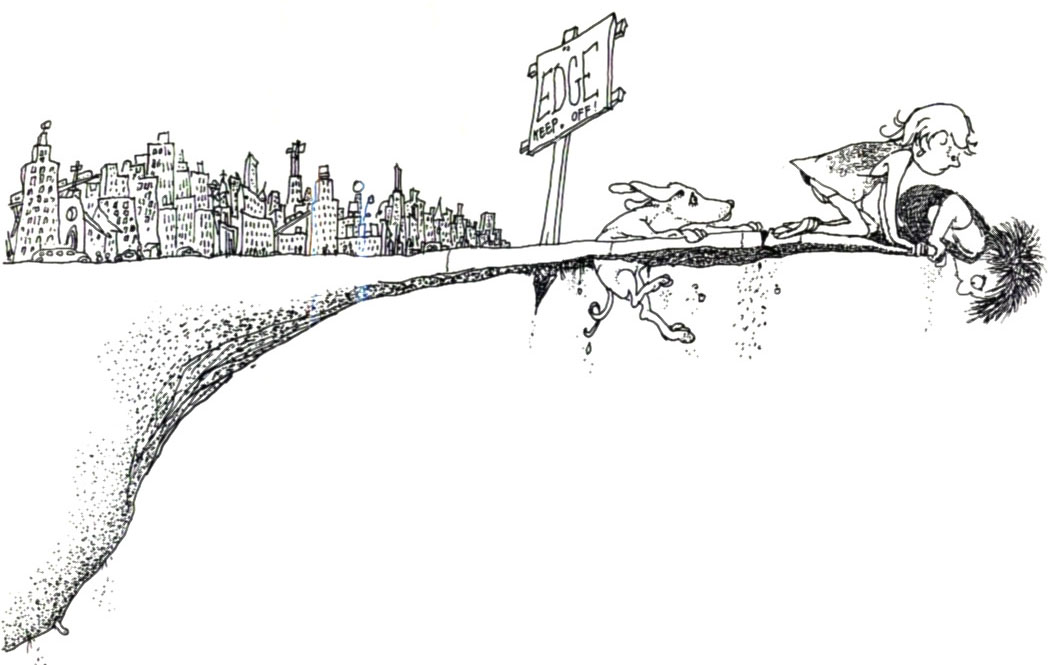
An illustration by Shel Silverstein based off of his poem
There is a place where the sidewalk ends
And before the street begins,
And there the grass grows soft and white,
And there the sun burns crimson bright,
And there the moon-bird rests from his flight
To cool in the peppermint wind.

Let us leave this place where the smoke blows black
And the dark street winds and bends.
Past the pits where the asphalt flowers grow
We shall walk with a walk that is measured and slow,
And watch where the chalk-white arrows go
To the place where the sidewalk ends.

Yes we'll walk with a walk that is measured and slow,
And we'll go where the chalk-white arrows go,
For the children, they mark, and the children, they know
The place where the sidewalk ends.

Shel Silverstein


Response:

          The poem "Where the Sidewalk Ends" by Shel Silverstein relays a theme to the reader, the children of our generation are the ones who can make a difference in the world.  This poem may seem to directly point out the problem of pollution, but it could apply to something larger, such as world peace.  Very often lines in poems symbolize something, mean more than what they do literally, like this one by Silverstein.
          Silverstein points out problems that we have in our world today and compares it to the world beyond the sidewalks that we are familiar with.  In the text it says, "Let us leave this place where the smoke blows black and the dark street winds and bends.  Past the pits where the asphalt flowers grow."  These lines specifically point out pollution and how our world has turned into a man-made place rather than nature.  Shel Silverstein also describes the world beyond the sidewalks he writes, "And there the grass grows soft and white, and there the sun burns crimson bright, and there the moon-bird rests from his flight to cool in the peppermint wind."  As he compares and describes both of these societies we really begin to see what Silverstein is comparing, a man-made world and nature.  Silverstein makes it clear that nature is better than a man-made world.  Silverstein's descriptions can also be applied to something larger, like world peace.  The way Silverstein describes these aspects of nature it brings a peaceful feeling to the reader.  While the man-made world seems kind of destructive.  Silverstein could be trying to get to the idea of world peace, a world beyond the one destroyed by man today.
          Silverstein then concludes the poem by explaining who can solve this problem, children.  In the text it says,"And we'll go where the chalk-white arrows go, for the children, they mark, and the children, they know the place where the sidewalk ends."  Silverstein is saying here that the children of our generations are the ones who can make a difference in our world, the ones who can lead the way to a new world.  When he writes about following the white-chalk arrows I think he is referring to the way children write with chalk on the sidewalks, something that we associate children with.  We as a world will follow the children who have the ability to lead the way to a better world.  Silverstein also writes, "Yes we'll walk with a walk that is measured and slow,"  What Silverstein means by this is that making this large change to our world will take time to accomplish.
          This poem still applies to our world today since we still face the problems of pollution and world peace.  Shel Silversteins words tell us that children in to step in and lead the way to a better world and the rest will follow.  If the children of our world today begin to take the steps that solve the problems we face in today's society we can make the world a much better place to live.  The next generation will change the world for years to come and if we start to take steps in the right direction slowly we will be able to solve our problems and create a world of peace.  


Wednesday, December 11, 2013

Social Justice and Fairness- The Okay Book by Todd Parr Response


The Okay Book by Todd Parr

How different are people allowed to be in this text?  Does it assume everyone is happy and good in the same ways?

               The Okay Book by Todd Parr talks about how it is okay to have different characteristics.  It teaches kids that it is okay to be different from other people.
               People in this text are allowed to be very different.  In the text it says, “It’s okay to be short, it’s okay to wear two different socks, it’s okay to come from a different place, it’s okay to cry, it’s okay to live in a small house…” the author then goes on to list all different groups that it is okay to be a part of.  The author makes it very clear with the repetition of “it’s okay to,” that being a part of all these different groups is okay.  Even though in this specific book there is no conflict, it lists a bunch of things people get discriminated against for and even incorporates some other problems such as economic issues.  Even the way people act and the lessons that are taught from this book revolve around these problems.  For example when the author writes, “it’s okay to be a different color” it clearly brings up the problem of racial discrimination.  When he writes, “it’s okay to live in a small house” he brings up somewhat of an economical issue, people who can’t afford big homes.  When the author writes, “it’s okay to be skinny” he brings up the issue of discrimination of physical appearance.  This book hints at many social issues and allows people to be very different.
                The author does assume that everyone is happy and good in the same ways.  Each sentence the author wrote introducing a new problem; he began with “it’s okay.” By using these same words for each and every issue he shows that they are all equally okay and accepted.  What the author does not show is the side where these people are not looked at as equals because of their differences.   But this is okay because younger kids wouldn’t understand the story anymore if the author had added this component.  The same lesson is still being taught whether or not this point of view is shown.  It doesn’t change the theme of the book.  His theme is simply it’s okay to be different.
                 Overall, The Okay Book allows people to be very different, and have different characteristics.  The author Todd Parr also allows all people in all groups to be happy in the same ways.  He shows the side where people of all different groups are equal.


By Caitlin Crowley 811

Wednesday, December 4, 2013

Reading Through a Lens of Social Justice- The Ugly Duckling Response


The Ugly Duckling from Landoll’s Fairy Tale Classics
One summer Mother Duck had a nest full of eggs.  The nest was near a pond, where cattails grew and dragonflies flew.  Mother duck sat on her eggs to keep them warm, until the day when they would hatch.  When that day came, little ducklings climbed out of their shells and ran around, filling the air with the sound, ‘cheep-cheep-cheep-cheep.”  But there was one egg that didn’t hatch with the rest.
            When the last egg finally hatched, out came a duckling quite different from the others.
            “There’s a funny duckling,” Mother Duck thought to herself while they were swimming one afternoon.  “This one is white instead of yellow, and a little bigger than the rest.”  Even so, Mother Duck loved her special duckling.
            But the others weren’t so nice.  “Look at you!” said a grown-up duck one day.  “You’re an ugly duckling.  You don’t belong here with the rest.”  The grown-up duck pushed away the odd duckling with its beak.
            After that, things grew worse.  The other ducklings liked to tease their strange brother.  They would nip him with their beaks and call him names.
            “You’re the Ugly Duckling!” they would yell.  Of course, this made the Ugly Duckling very upset.  All he wanted was to be liked.
            Even the wild songbirds scattered whenever the Ugly duckling came near.  “Look out, look out, it’s the Ugly Duckling!” they yelled, flying away from him.  “I must be one ugly bird,” thought the sad Ugly Duckling.  “I’m so ugly I don’t even have a friend.”
            Without any friends, the Ugly duckling had to swim by himself.  One day, all alone, he saw a flock of larger birds flying above the water.  “Look at them,” he said.  “They’re so beautiful—the shape of their wings, the color of their heads, the way they glide through the air.” He sighed.  “And I am just an Ugly Duckling.”
            The seasons changed from summer to fall, then came cold winter and green spring.  Through them all, the Ugly duckling was on his own, unable to find a friendly face.  It was a miserable thing, being alone and feeling ugly.
            One night in early spring, under the light of the full moon, the Ugly Duckling saw another flock of beautiful birds.  They were flying through the sky, glowing in the moonlight, and the Ugly Duckling squawked to them: “I wish I was as beautiful as you!”
            But the Ugly Duckling was in for a surprise.  That spring, a remarkable change occurred in him.  First, his stubby little wings had grown long and strong, and with these he had learned to fly.  The Ugly Duckling was proud.  “I’m not a duckling anymore,” he thought to himself.  Then he wondered, “I don’t feel ugly—and if I don’t feel ugly then I must be fine.”  Then one day he flew down toward a group of elegant swans with long, curving necks.  He landed near them, thinking they might hiss at him of fly away.
            Instead, the swans approached him.  As they swam closer, the Ugly Duckling felt afraid because he thought he might be attacked.  “ What a lovely creature you are,” they told him.  The Ugly Duckling felt embarrassed.  He thought they were mocking him.  But when he looked down in shame, what did he see?  His reflection on the water—it was the face, neck and body of a beautiful swan.  “Why yes,’ he said, gazing at his reflection.  “I am a lovely creature.  And most importantly, I feel like a lovely creature.”


Response:

            The Ugly Duckling is a very popular children’s fable.  It is obvious that the book teaches a lesson about some form of discrimination, or for younger children, teaches to treat others the way you want to be treated.  But the book has hidden signs of discrimination that might be hard for younger children to pick out.  The book specifically hints towards racial discrimination.
            One way this book hints towards racial discrimination is because the duckling is treated differently because of the color of its feathers.  This is one of the more obvious hints to older kids, but younger kids might not be able to pick that up.  In the text it says,” This one is white instead of yellow.”  Another way this book hints towards racial discrimination is showing that the duckling was discriminated by a grown—up duckling.  This shows that it was more than just being teased by kids, it was discrimination on a larger level, being teased by all people, or in this case ducks.  In the text it says, “You’re an ugly duckling.  You don’t belong here with the rest.’ The grown-up duck pushed away the odd duckling with its beak.”  The grown-up duck not only made fun of the duckling because of its feathers, but also pushed it away and told it that it didn’t belong with the rest of the ducks.  This really shows discrimination, showing that the grown-up duck told the duckling that it didn’t belong with the other ducks because of the way it looked points out racial discrimination to the reader.
            The author also reminds the reader of the racial problems that occurred in the United States in the 20th Century.  In the text its says, “The other ducklings liked to tease their strange brother.  They would nip him with their beaks and call him names.”  First of all I think it is symbolic that the author writes that his brothers started to discriminate the duckling.  I think this symbolizes the idea that African Americans, whom were American citizens, were being discriminated by other American citizens, by their own brothers.  Another thing the author writes is that the other ducklings nipped at him and called him names.  What I think the author is trying to hint at here is the violence that occurred and how African Americans were physically abused because of their skin color.  While obviously it isn’t as brutal here, it still hints at this.  The name calling also relates to the time period, with all the horrible names that African Americans were called.
            At the end of the book the duckling realizes that just because he was treated differently and discriminated against because of his feather color, he shouldn’t live feeling bad about himself and dwelling on the fact that he is different.  Instead, he learns that he is just as beautiful as all the other ducklings.  This relates to racial discrimination in the United States.  African Americans stayed strong through the time period of discrimination, knowing that they were equal to all people and because of their persistence they finally achieved their rights as equal American citizens.
            The Ugly Duckling teaches an important lesson to children, to treat others the way you want to be treated, but for older kids several hints towards racial discrimination can be found.  


By:  Caitlin Crowley  811

Friday, September 27, 2013

Faithful Elephants Response- Theme


Faithful Elephants by Yukio Tsuchiya
            In the short story Faithful Elephants by Yukio Tsuchiya, three elephants, John, Tonky, and Wanly are killed at the Ueno Zoo during World War II.  In the book bombs were being dropped on Tokyo day and night and the government was concerned that the animals in the zoo would escape during one of these bombings.  So they ordered all the animals in the zoo to be killed.  The author teaches readers that war affects people and their surroundings.
            In the short story, the war not only affects the people fighting it, but the trainers also.  For example in the text it says, “He carried food and pails of water to them and threw it at their feet.  ‘Here’ he said sobbing and clung to their thin legs.”  The zookeeper brought food and water to the elephants even though he was instructed not to.  He risked getting in a lot of trouble in order to help the elephants.  This shows how much he truly cares about them.  Also the fact that the other zookeepers pretended that they had not seen the keeper give the elephants food, shows they too cared deeply about the elephants and hated to watch them suffer.  When the elephants died the zookeepers were devastated.  This shows how the war negatively affected the zookeepers.
The elephants too, were obviously, affected in a negative way by the war.  They didn’t understand why people had stopped feeding them.  In the text it says,
            Whenever a keeper walked by their cage, they would stand up, tottering as if to beg, “Give us something to eat.  Please give us water!”  Their small, loving eyes began to look like round rubber balls in their drooping, shrunken faces.  Their ears seemed too large for their bodies.  The once big, strong elephants had become a sad shape.
The elephants suffered, and they didn’t understand why.  This shows how war affects people and what is around them.
            Yukio Tsuchiya teaches her readers that war affects people and their surroundings in negative ways.  She challenges readers to make a point that war is evil and because of it three innocent animals were killed.  She wants us to learn and understand that war only pains people and their surroundings.  Benjamin Franklin once said, “There was never a good war, or a bad peace.”  Meaning, war doesn’t bring anything good into the world, especially peace.

Wednesday, September 18, 2013

Before We Were Free by Julia Alvarez - Summer Reading Response


Before We Were Free by Julia Alvarez
Before We Were Free by Julia Alvarez teaches readers that people should not give up fighting for their freedom.  Freedom is definitely a common theme throughout the book and characters, like Chucha, and Papi spread that theme.
Chucha makes clear this theme.  For example in the text its says, “she told me of a dream she had in which first Lucinda, then Mundin, then Mami and I sprouted wings and flew up into the sky.”  This line is very symbolic because flying is symbolizing their freedom from the brutal dictator, El Jefe.  When Chucha tells Anita (the main character) about this dream she had, she is giving her hope that they will eventually reach their freedom.
Papi also makes this theme really clear.  For example in the text it says, “I want my children to be free, no matter what.  Promise me (Anita) you’ll spread your wings and fly.”  Papi also tries to get Anita to have hope and never give up trying to reach freedom, through a promise.  He wants her to be brave and fight for her freedom, so that one day she will be free.
Overall, freedom is a very common thread in this book and is often symbolized with this idea of flying.  Flying to their freedom.